💬 Introduction
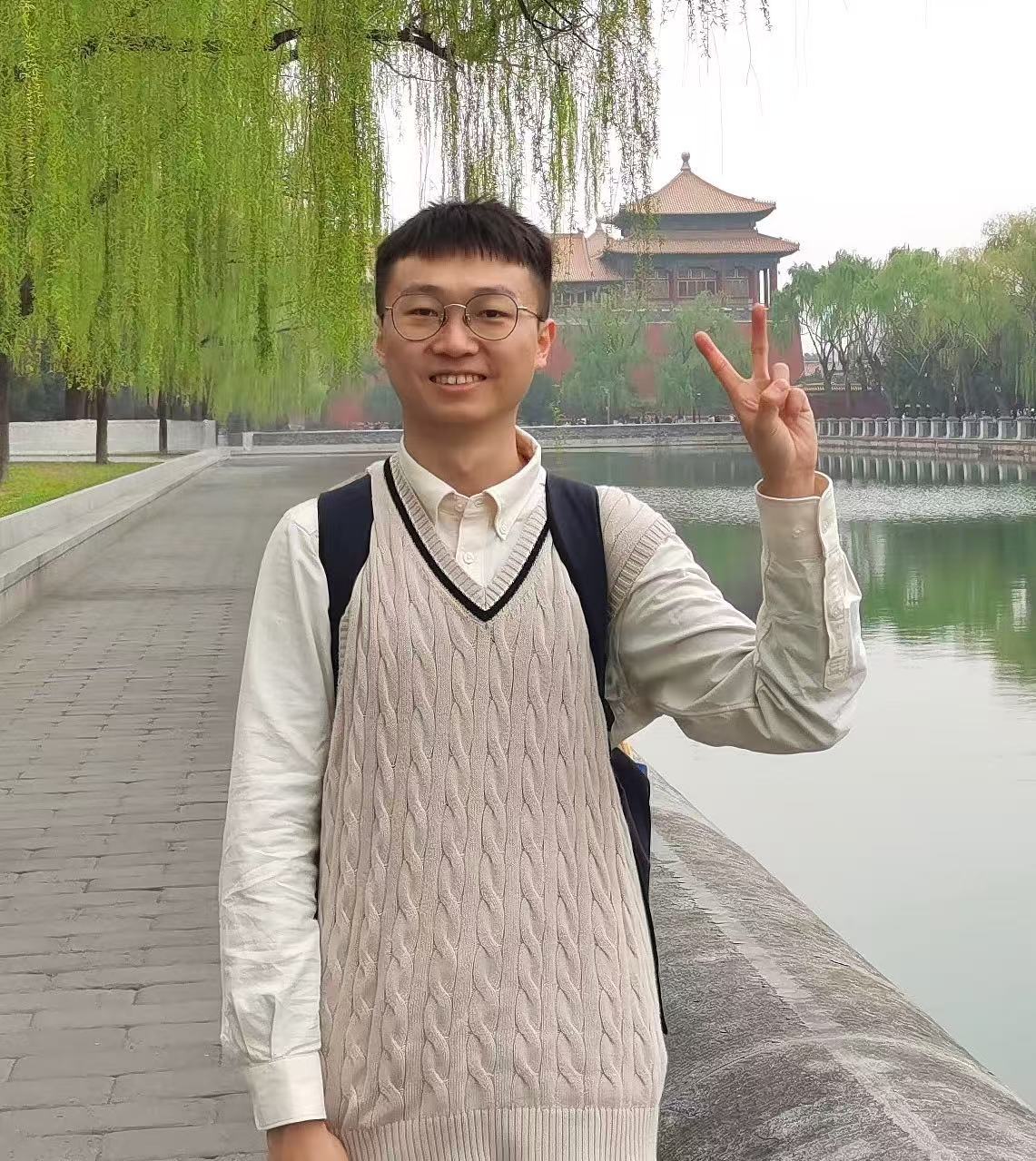
I enrolled at Fudan University in 2018, initially studying Electronic Engineering, where I gained experience in programming and analog and digital circuit design. In 2020, I transferred to Physics and earned my B.Sc. in 2023 and an M.Sc. in Theoretical Physics in 2026. I am currently pursuing a second Master’s degree in AI for Science at the National University of Singapore. My research focuses on developing AI algorithms tailored to scientific problems and accelerating scientific discovery.
📧 Email: xiao-cao@u.nus.edu & xcao23@m.fudan.edu.cn & 18307130225@fudan.edu.cn & 1550892430@qq.com
🎓 Education
-
2026 - present M.Sc. in AI For Science, Faculty of Science, National University of Singapore, Singapore
-
2023 – 2026 M.Sc. in Physics, Department of Physics, Fudan University, Shanghai, China
GPA: 3.84 / 4.00 (96/100) Major GPA: 3.92 / 4.00 (98/100) -
2018 – 2023 B.Sc. in Physics, Department of Physics, Fudan University, Shanghai, China
GPA: 3.83 / 4.00 (96/100) Rank: 3rd / 85
📚 Publications
Published Papers
-
Yunxiao Ye, Xiao Cao, Yu-Hang Wu, and Jiayin Gu. “Positivity bounds in scalar-QED EFT at one-loop level.” Journal of High Energy Physics 10 (2025) 084. arXiv · Project
-
Xiao Cao, Cuiqin Bai, et al. “COMSOL Simulation of Ferrite Microwave Circulator.” College Physics, vol. 41, no. 9, 2022, p. 63.[link] · Project
Manuscripts in Preparation
- Xiao Cao, Zening Xuan, Liangliang Shi, and Hao Xiong.
“PGDFlow: From Backpropagation to Forward Generation via Flow Matching.”
Manuscript in preparation. · Project
⚛️ Research Experience
- One-Loop Positivity Bounds in Scalar-QED EFT · Published in JHEP, Oct. 2025 · Project
- Studied how one-loop corrections affect positivity bounds in scalar-QED effective field theory, using photon–scalar and photon–photon scattering amplitudes and dispersion relations.
- Examined the roles of gauge invariance, infrared regularization, and renormalization-group evolution, with checks in heavy-scalar UV models. Paper
- PGDFlow—Generative Optimization via Flow Matching · Ongoing Research · Project
- Developing a conditional flow-matching approach that learns distributions of optimizer solutions and investigates forward generation as an alternative to per-instance iterative search.
- Studying shared solution structure, mode conditioning, and input-dependent noise priors, with ongoing evaluation on adversarial examples, black-box optimization, and the 2D XY model.
- Machine Learning for Top-Quark EFT · Ongoing Research · Project
- Exploring machine-learning-assisted inference of SMEFT Wilson coefficients in top-quark pair production and semileptonic decay at future electron–positron colliders.
- Connecting optimal observables with simulation-based inference by learning parameter-sensitive scores from simulated events, with the aim of supporting likelihood-based inference while accounting for detector effects.
- 2026.04–2026.06: Quantization and Inference Optimization for Learned Image Compression · Project
- Conducted research at China Telecom Shanghai Research Institute on the edge deployment of learned image compression models, focusing on post-training quantization and fixed-point inference across FP16, BF16, INT8, and INT12 formats.
- Developed evaluation pipelines to benchmark quantization effects on encoder, decoder, and attention modules, demonstrating that INT12 fixed-point activations provide a theoretical storage reduction of 62.5% compared with FP32 representations.
- 2021.09–2022.03: Electromagnetic Simulation and Optimization of a Ferrite Microwave Circulator · Project
- Developed a three-dimensional finite-element model using the COMSOL RF Module and implemented an anisotropic permeability tensor to study nonreciprocal electromagnetic transmission under an external bias field.
- Performed parametric sweeps and analyzed electric-field distributions, power flow, and S-parameters to optimize the device geometry, achieving an operating range of 8.8–9.5 GHz and a minimum reflection coefficient of S₁₁ = −43.04 dB.
🛠️ Skills
-
Machine Learning and Deep Learning: Proficient in PyTorch; familiar with Transformer architectures, diffusion models, and flow matching; experienced in model training, optimization, and inference acceleration.
-
Programming and Development Tools: Proficient in Python, with foundational knowledge of Java, C, and C++; familiar with Linux development environments, Git, and deep-learning engineering workflows.
-
Scientific Background: Statistical physics and thermodynamics, quantum field theory, quantum mechanics, and particle physics.
-
English Proficiency: IELTS Overall Band 7.0; CET-4: 584; CET-6: 543.
🏆 Honors and Awards
- 2024-2025 Xiaomi Special Scholarship, Fudan University, Top 10 Master’s Student university-wide, awarded per National Scholarship criteria.
- 2023: Outstanding Graduate, Fudan University
- 2022–2023: First Prize Scholarship for Outstanding Students, Fudan University
- 2023–2024: Master’s Excellence Scholarship (Outstanding Level), Fudan University
- 2023–2024: Master’s Academic Scholarship, Fudan University
- 2021–2022: Second Prize Scholarship for Outstanding Students, Fudan University
- 2022: Undergraduate Major Scholarship, Fudan University
- 2020–2021: Second Prize Scholarship for Outstanding Students, Fudan University
- 2021: Undergraduate Major Scholarship, Fudan University
- 2019–2020: Second Prize Scholarship for Outstanding Students, Fudan University
- 2018–2019: Second Prize Scholarship for Outstanding Students, Fudan University