Ongoing Research
Machine Learning for Top-Quark EFT
Connecting optimal observables with simulation-based inference for top-quark effective field theory.
Ongoing research · Unpublished work
Overview
This project explores machine-learning-assisted statistical inference for top-quark effective field theory at future electron–positron colliders. It connects the optimal observable approach with simulation-based inference to study how information about new physics can be extracted from complex collider events.
Motivation
Top-quark pair production and decay provide a valuable setting for studying interactions beyond the Standard Model within the Standard Model Effective Field Theory (SMEFT). The kinematic structure of these events carries information about the underlying interactions, motivating methods that can use correlations across the full event.
Traditional analyses often summarize events through selected angular distributions or other individual observables. Optimal observables offer a statistically motivated way to extract parameter-sensitive information. Applying them to realistic measurements, however, is challenging: parton showers, hadronization, and detector response transform the underlying event, making the detector-level likelihood difficult to evaluate directly.
Physical Process
The study considers top-quark pair production in electron–positron collisions, followed by semileptonic decay. One W boson decays leptonically and the other hadronically, giving a final state containing a charged lepton, a neutrino, and jets.
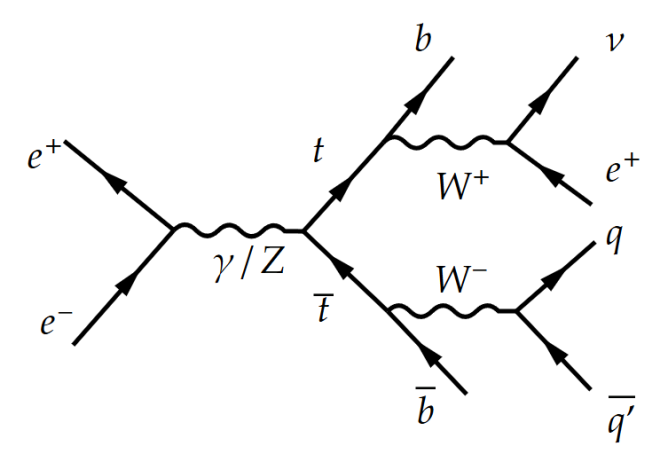
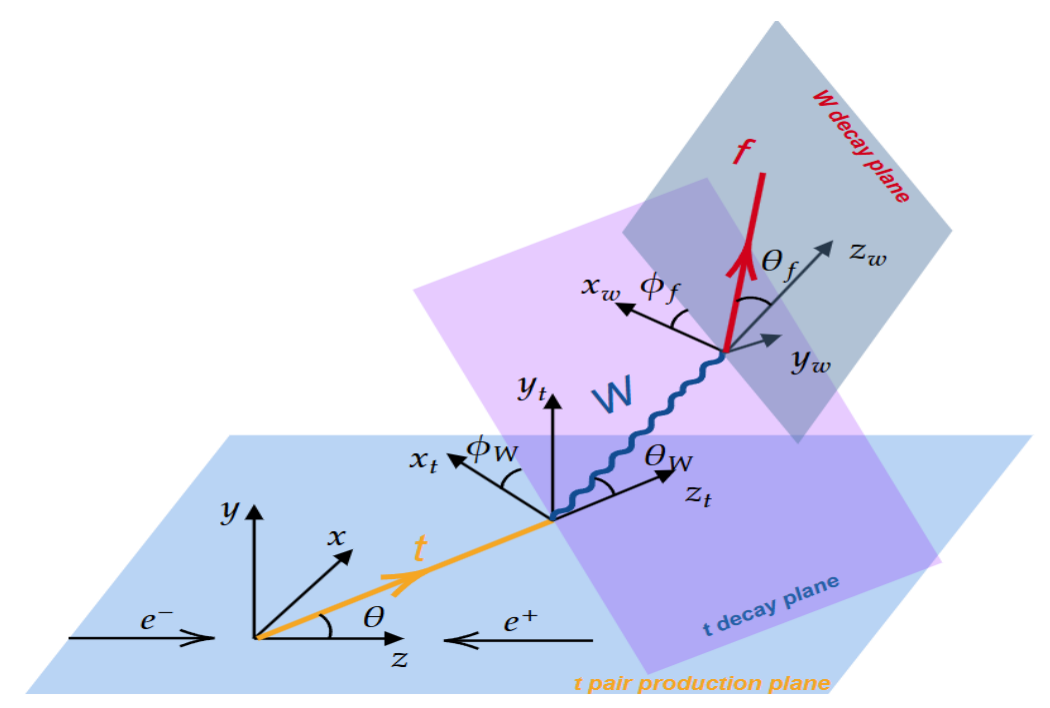
The production and sequential decays can be described through angles defined in the relevant rest frames. Figure 2 illustrates the coordinate systems and decay planes used to describe this event geometry.
Method Overview
The approach uses simulated events to connect information available in the underlying physics calculation with observable event features. A neural network learns parameter-sensitive summaries, or scores, that serve as a machine-learning counterpart of optimal observables.
These learned summaries support likelihood-based inference of EFT Wilson coefficients while accounting for the transformations between the underlying scattering process and reconstructed events. The project brings together analytical particle physics, event simulation, and statistical learning.
This page provides a high-level overview of ongoing, unpublished research. Numerical results and implementation details are omitted.